U.S. Role in 2026 Global Economic Governance: Policy Debates
Advertisements
The U.S. role in 2026 global economic governance is central to upcoming policy debates concerning trade, climate change finance, and digital economy regulations, directly impacting international stability and prosperity.
As 2026 approaches, the global economic landscape continues its rapid evolution, presenting both unprecedented opportunities and significant challenges. The US global economic governance role remains paramount, with its policies and diplomatic efforts poised to shape the trajectory of international finance, trade, and development. Understanding these upcoming policy debates is crucial for anyone seeking to grasp the future direction of the world economy.
The evolving landscape of global economic governance
Global economic governance refers to the collective institutions, rules, and practices that guide economic interactions among nations. In recent years, this framework has faced immense pressure from geopolitical shifts, technological advancements, and pressing global challenges like climate change and pandemics. The United States, as the world’s largest economy and a key player in multilateral institutions, has historically been a primary architect and enforcer of these rules.
However, the rise of new economic powers and a more multipolar world order means the U.S. must navigate a complex web of interests and perspectives. The foundational principles of institutions like the International Monetary Fund (IMF), the World Bank, and the World Trade Organization (WTO) are being re-evaluated, and the U.S. approach to these discussions will significantly influence their future efficacy and legitimacy.
Challenges to multilateralism and U.S. leadership
The traditional multilateral system is under strain. Protectionist sentiments, trade disputes, and the weaponization of economic tools have eroded trust and cooperation. The U.S. faces the delicate task of asserting its leadership while fostering inclusivity and addressing the legitimate concerns of other nations.
- Trade Tensions: Ongoing disputes and the rise of bilateral agreements challenge the WTO’s role.
- Geopolitical Rivalries: Competition with rising powers impacts economic alliances and supply chain resilience.
- Institutional Reform: Calls for greater representation and reform within existing global bodies.
The U.S. response to these challenges will define its leadership in 2026. Will it lean into renewed multilateral engagement, or will it prioritize unilateral actions? This choice has profound implications for global economic stability and the ability to collectively address shared problems.
Ultimately, the evolving landscape demands a nuanced and adaptable U.S. strategy. Maintaining relevance and influence requires not just economic might, but also diplomatic agility and a willingness to forge new consensus.
Trade policy: navigating protectionism and new agreements
Trade policy remains a cornerstone of the US global economic governance strategy. As 2026 approaches, the U.S. is grappling with the twin pressures of domestic industrial policy and the need to maintain open, fair international markets. The legacy of past trade agreements and the emergence of new geopolitical blocs are creating a dynamic and often contentious environment for future negotiations.
The U.S. administration will continue to balance the protection of domestic industries and jobs with the benefits of global trade. This involves a careful assessment of tariffs, subsidies, and non-tariff barriers, particularly in strategic sectors like technology, clean energy, and critical minerals. The goal is to ensure national security and economic resilience without completely isolating the U.S. from global supply chains.
Reforming the World Trade Organization (WTO)
The WTO’s dispute settlement mechanism has been largely paralyzed, hindering its effectiveness in resolving trade conflicts. The U.S. has been a vocal critic, pushing for reforms that address concerns about state-owned enterprises, intellectual property theft, and forced technology transfers. The upcoming debates will center on:
- Restoring the Appellate Body: Finding common ground for a functioning dispute resolution system.
- Updating Trade Rules: Addressing digital trade, environmental goods, and subsidies.
- Ensuring Fair Competition: Tackling practices perceived as distorting global markets.
Progress on WTO reform is critical for reinforcing a rules-based trading system, which the U.S. has long championed. A revitalized WTO could provide a more predictable and equitable environment for international commerce.
Beyond multilateral efforts, the U.S. is also exploring regional and bilateral trade agreements. These agreements often serve to deepen economic ties with key allies, set high standards for labor and environmental protections, and counter the influence of competitors. The strategic calculus behind these agreements will be a significant element of U.S. trade policy debates in 2026, aiming to create resilient and secure supply chains while promoting economic growth.
Climate finance and sustainable development goals
The intersection of economic policy and climate change has become an inescapable reality, placing climate finance and sustainable development goals (SDGs) at the forefront of the U.S. global economic agenda. In 2026, the U.S. will face increased pressure to demonstrate leadership in mobilizing resources for climate action and supporting developing nations in their transition to green economies.
The commitment to achieving the Paris Agreement goals requires massive investments in renewable energy, climate resilience, and adaptation. Developing countries, often the most vulnerable to climate impacts, require significant financial and technological support. The U.S. role involves not only its own direct contributions but also leveraging its influence within multilateral development banks (MDBs) and other international financial institutions.
Mobilizing private capital for climate solutions
Government funding alone cannot meet the scale of climate finance needed. A key U.S. policy debate will revolve around innovative mechanisms to unlock private sector investment. This includes:
- Risk Mitigation Instruments: Guarantees and blended finance to de-risk green investments in emerging markets.
- Carbon Pricing Mechanisms: Exploring international cooperation on carbon markets and border adjustments.
- Green Bonds and Sustainable Finance: Promoting standards and frameworks for sustainable financial products.
The U.S. will seek to align domestic climate initiatives, such as incentives for clean energy, with its international climate finance strategy. This alignment is crucial for demonstrating credibility and encouraging other nations to follow suit. The debates will also touch upon the equitable distribution of climate finance, ensuring that the most vulnerable populations receive adequate support.
Furthermore, the U.S. approach to sustainable development extends beyond climate, encompassing broader SDGs related to poverty reduction, health, and education. Integrating these goals into economic policy frameworks will be essential for a holistic and impactful U.S. global governance strategy in the coming years.
Digital economy regulation and innovation
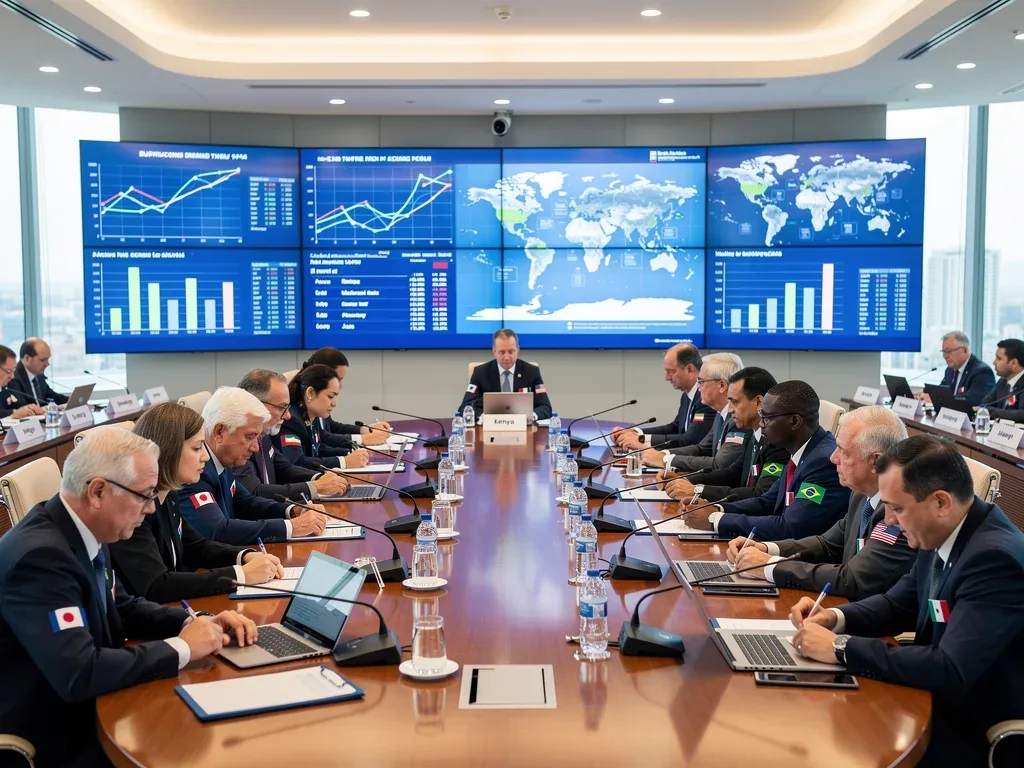
The rapid expansion of the digital economy presents a new frontier for US global economic governance. In 2026, policy debates will intensify around regulating digital markets, ensuring data privacy, and fostering innovation while addressing concerns about market dominance and cybersecurity. The U.S., home to many of the world’s leading tech companies, holds a unique position in shaping these global norms.
International cooperation is vital given the borderless nature of digital services and data flows. The U.S. will need to engage with diverse regulatory approaches from Europe, Asia, and other regions, seeking to find common ground that protects consumers, promotes fair competition, and does not stifle technological advancement. This involves navigating complex issues such as digital taxation, antitrust enforcement in tech, and the ethical implications of artificial intelligence.
Key areas of digital policy debate
Several critical areas will define the U.S. approach to digital economy regulation:
- Data Governance: Establishing international standards for data privacy, cross-border data flows, and data localization.
- Digital Taxation: Collaborating on global frameworks to ensure multinational tech companies pay their fair share of taxes.
- Antitrust and Competition: Addressing concerns about monopolies and promoting fair competition in digital markets.
- Cybersecurity: Developing international norms and cooperation mechanisms to combat cyber threats and protect critical infrastructure.
The U.S. strategy will likely involve a multi-pronged approach, combining bilateral dialogues with multilateral initiatives. The goal is to create a predictable and secure digital environment that supports growth and innovation, while also addressing the societal and economic challenges posed by rapid technological change. These debates are crucial for preventing a fragmented global digital landscape.
Ultimately, the ability of the U.S. to lead in digital economy governance will depend on its capacity to balance competing interests and forge consensus among diverse stakeholders, both domestically and internationally. This requires foresight and a deep understanding of emerging technologies and their implications.
Reforming international financial institutions
The effectiveness and legitimacy of international financial institutions (IFIs) like the IMF and the World Bank are under constant scrutiny, and their reform will be a significant aspect of the US global economic governance agenda in 2026. These institutions were largely designed in the post-World War II era, and many argue they no longer adequately reflect the current economic realities or the distribution of global power.
The U.S., as the largest shareholder in both the IMF and the World Bank, plays a critical role in driving or impeding reform efforts. The debates will center on increasing the representation of emerging economies, enhancing the institutions’ capacity to address new global challenges, and ensuring their financial resources are sufficient and appropriately deployed.
Addressing debt sustainability and global financial stability
A persistent challenge for IFIs is promoting debt sustainability, especially for low-income countries facing multiple shocks. The U.S. will be central to discussions on:
- Debt Relief Mechanisms: Improving frameworks for sovereign debt restructuring and relief.
- Strengthening Financial Safety Nets: Ensuring the IMF has adequate resources to prevent and mitigate financial crises.
- Addressing Capital Flows Volatility: Developing tools to manage disruptive cross-border capital movements.
The U.S. has a vested interest in a stable global financial system. Its policy stance on IFI reforms will reflect a balance between maintaining its influence and acknowledging the need for greater inclusivity and responsiveness. This includes advocating for governance reforms that give a stronger voice to developing nations, thereby enhancing the legitimacy and effectiveness of these vital institutions.
The upcoming policy debates will also explore how IFIs can better support countries in achieving the SDGs and transitioning to greener economies. This involves re-evaluating lending policies, technical assistance programs, and partnerships with other development actors to maximize impact. The U.S. commitment to these reforms is crucial for the continued relevance of the global financial architecture.
Geopolitical shifts and economic alliances
The geopolitical landscape is undergoing profound transformations, directly impacting the contours of US global economic governance. In 2026, the U.S. will continue to navigate a complex interplay of competition and cooperation with major powers, while simultaneously strengthening economic alliances with like-minded nations. These shifts are redefining global supply chains, investment patterns, and the very structure of international economic relations.
The rise of new economic centers, particularly in Asia, has challenged the U.S.’s traditional dominance. This necessitates a strategic recalibration, focusing on building resilient partnerships and diversifying economic dependencies. The U.S. approach will involve fostering economic integration with allies, promoting shared values in trade and investment, and strategically countering economic coercion or unfair practices.
Strengthening economic partnerships and supply chain resilience
A key focus for the U.S. will be enhancing economic security through robust alliances. This includes:
- Friend-Shoring and Near-Shoring: Rerouting supply chains to trusted partners and closer geographies.
- Critical Mineral Security: Collaborating with allies to secure access to essential resources.
- Technology Alliances: Jointly developing and protecting advanced technologies.
These initiatives are designed to reduce vulnerabilities and build collective economic strength. The U.S. will engage in dialogues with groups like the G7, G20, and QUAD, seeking to coordinate economic policies and present a united front on issues ranging from trade and investment to technology standards and development finance.
The debates in 2026 will also address the economic implications of ongoing conflicts and regional instabilities. The U.S. will need to deploy economic tools, such as sanctions and aid, strategically to promote peace and stability, while minimizing unintended consequences for global markets. Managing these complex geopolitical dynamics effectively will be central to maintaining U.S. influence and promoting a stable international economic order.

The future of U.S. leadership in global economic governance
Looking ahead to 2026, the future of U.S. leadership in global economic governance hinges on its ability to adapt, innovate, and collaborate. The era of unquestioned American economic hegemony has evolved into one of shared responsibility and complex interdependence. The U.S. must continue to champion open markets, democratic values, and a rules-based international order, but do so with a renewed understanding of global diversity and shared challenges.
The policy debates will focus on how the U.S. can best leverage its economic power and diplomatic influence to address pressing issues like climate change, digital transformation, and persistent inequalities. This requires not only projecting strength but also demonstrating empathy, flexibility, and a genuine commitment to multilateral solutions. The pursuit of national interests must be harmonized with global collective action.
Key pillars for sustained U.S. influence
Maintaining and strengthening U.S. leadership will depend on several critical factors:
- Domestic Economic Strength: A robust and innovative U.S. economy provides the foundation for international influence.
- Strategic Alliances: Deepening economic and security ties with key partners globally.
- Adaptability to New Challenges: Proactive engagement on emerging issues like AI governance and biosecurity.
- Renewed Multilateral Engagement: Actively participating in and reforming international institutions.
The U.S. will need to articulate a compelling vision for global economic cooperation that resonates with a broad range of countries. This vision should emphasize shared prosperity, sustainable growth, and resilience in the face of future shocks. The debates will ultimately shape whether the U.S. can continue to be a primary architect of the global economic order or if its influence will wane in favor of alternative models.
The coming years will test the U.S.’s diplomatic prowess and its capacity to forge consensus in an increasingly fragmented world. Its choices in these policy debates will have lasting ramifications for its own prosperity and global stability.
| Key Policy Area | U.S. Focus in 2026 |
|---|---|
| Trade Policy | Balancing domestic protection with open markets, WTO reform, and new bilateral agreements. |
| Climate Finance | Mobilizing private capital, supporting developing nations, and leveraging MDBs for climate action. |
| Digital Regulation | Shaping global norms for data, taxation, antitrust, and cybersecurity in the digital economy. |
| IFI Reform | Enhancing representation for emerging economies and strengthening financial stability mechanisms. |
Frequently asked questions about U.S. global economic governance
What are the primary challenges to U.S. global economic governance in 2026?▼The U.S. faces challenges including geopolitical rivalries, trade protectionism, and the need for institutional reforms within multilateral economic bodies. These factors complicate efforts to maintain a stable and predictable global economic order, requiring adaptable strategies.
How will U.S. trade policy evolve in response to global shifts?▼U.S. trade policy will balance domestic industrial protection with efforts to reform the WTO and pursue new bilateral or regional agreements. The focus will be on securing supply chains, addressing unfair trade practices, and promoting fair competition in strategic sectors.
What is the U.S. role in climate finance for sustainable development?▼The U.S. is crucial in mobilizing climate finance by leveraging multilateral development banks and encouraging private sector investment. Its role involves supporting developing nations’ transition to green economies through innovative financing and technology transfer.
What are the key U.S. policy debates regarding the digital economy?▼Key debates include establishing international standards for data governance, digital taxation, antitrust enforcement for tech giants, and global cybersecurity cooperation. The U.S. aims to balance innovation with regulation to ensure fair and secure digital markets.
How does geopolitical competition influence U.S. economic alliances?▼Geopolitical competition drives the U.S. to strengthen economic alliances through initiatives like friend-shoring supply chains and technology partnerships. The goal is to enhance collective economic security, reduce dependencies, and counter economic coercion from rival powers.
Conclusion
The US global economic governance role in 2026 is poised at a critical juncture, navigating a world marked by profound economic, technological, and geopolitical shifts. The upcoming policy debates across trade, climate finance, digital regulation, and institutional reform will test American leadership and its capacity to forge consensus in an increasingly multipolar world. Sustained U.S. influence will depend on its ability to champion an inclusive, rules-based international order while effectively addressing both domestic priorities and shared global challenges. The choices made in these critical discussions will not only shape the U.S.’s economic future but also the trajectory of global prosperity and stability for years to come.