2026 Global Automation Trends: Impact on U.S. Labor Markets
Advertisements
Global automation trends by 2026 are poised to fundamentally reshape the U.S. labor market, driving demand for new skills while displacing traditional roles across various industries.
As we approach 2026, the discussion around global automation trends and their impact on U.S. labor markets intensifies. What was once science fiction is now an undeniable reality, with artificial intelligence, robotics, and advanced software rapidly integrating into every facet of industry. This evolution isn’t merely about efficiency; it’s about a profound paradigm shift in how work is conceived, executed, and valued. Understanding these changes is crucial for policymakers, businesses, and individual workers alike, as the landscape of employment transforms before our eyes. The coming years will demand not just adaptation, but proactive innovation to harness the opportunities and mitigate the challenges presented by this technological revolution.
The accelerating pace of automation and AI integration
The speed at which automation and artificial intelligence are being adopted across sectors is unprecedented. From manufacturing lines to customer service centers, intelligent systems are taking over repetitive, data-intensive, and even complex analytical tasks. This rapid integration is driven by several factors, including cost reduction, increased precision, and the ability to operate 24/7 without fatigue. Businesses are realizing significant competitive advantages by deploying these technologies, leading to a widespread embrace that shows no signs of slowing down.
This acceleration is not uniform; some industries are experiencing a more profound and immediate transformation than others. Sectors heavily reliant on manual labor or routine data processing are at the forefront of this change, while creative and interpersonal roles are currently less affected, though not entirely immune. The trend indicates a future where human and machine collaboration becomes the norm, rather than the exception.
Key drivers of automation adoption
- Economic efficiency: Reducing operational costs and increasing output.
- Precision and quality: Minimizing errors and ensuring consistent product/service quality.
- Scalability: Ability to scale operations rapidly without increasing human workforce proportionally.
- Data processing capabilities: Handling and analyzing vast amounts of data at speeds impossible for humans.
The ongoing development of AI algorithms, particularly in machine learning and natural language processing, continues to expand the capabilities of automated systems. This means that tasks once considered exclusively human domains, such as complex problem-solving and even creative endeavors, are now being augmented or, in some cases, performed by AI. This evolution forces a reevaluation of what constitutes ‘human work’ in the modern economy.
In conclusion, the accelerating pace of automation and AI integration is a defining characteristic of the current economic landscape. It is reshaping industrial processes and demanding a fundamental shift in how we approach labor and skill development. The drivers behind this adoption are powerful, suggesting that this trend will only intensify in the years leading up to and beyond 2026, profoundly influencing the U.S. labor market’s structure.
Projected job displacement and creation by 2026
One of the most pressing concerns regarding global automation trends is its dual impact on job markets: displacement and creation. While automation is often associated with job losses, particularly in predictable and routine tasks, it also simultaneously creates new roles that require different, often higher-level, skills. By 2026, the U.S. labor market will likely see a significant reshuffling of its workforce composition, with some sectors experiencing net losses and others significant gains.
Studies and economic forecasts suggest that jobs involving repetitive physical tasks, data entry, and basic administrative functions are most vulnerable to automation. Manufacturing, transportation, and certain administrative support roles are already feeling the effects. However, the exact scale of displacement remains a subject of ongoing debate, with estimates varying widely based on assumptions about technological progress and economic policies.
Sectors most affected by displacement
- Manufacturing: Assembly line workers, machine operators.
- Transportation: Truck drivers, taxi operators (due to autonomous vehicles).
- Administrative support: Data entry clerks, customer service representatives.
- Retail: Cashiers, stock clerks.
Conversely, the rise of automation is fueling demand for new types of jobs. These include roles in AI development, robotics engineering, data science, cybersecurity, and fields requiring unique human skills like creativity, critical thinking, and emotional intelligence. The maintenance and oversight of automated systems also create new positions, along with roles focused on ethical AI development and human-machine interaction design.
The challenge lies in ensuring that the newly created jobs are accessible to those whose roles are displaced. This requires significant investment in education, reskilling, and workforce development programs. Without these interventions, the gap between the skills available and the skills demanded could widen, leading to increased unemployment and social inequality. The transition will not be seamless, but strategic planning can mitigate negative outcomes.
In summary, 2026 will be a critical juncture for understanding the net effect of automation on U.S. employment. While job displacement in certain areas is inevitable, the potential for new job creation, particularly in technology-driven fields and those emphasizing human-centric skills, is substantial. Navigating this shift effectively will depend on robust educational and training initiatives.
The evolving landscape of required skills
As automation permeates industries, the skill sets valued in the U.S. labor market are undergoing a profound transformation. Traditional vocational skills remain important, but there is an increasing emphasis on cognitive and socio-emotional abilities that machines cannot easily replicate. This shift necessitates a re-evaluation of educational curricula and professional development strategies to prepare the workforce for the demands of 2026 and beyond.
Employers are actively seeking individuals who can work alongside intelligent systems, manage complex data, and adapt to rapidly changing technological environments. Technical proficiency in areas like coding, data analytics, and cybersecurity is becoming foundational across a broader range of professions, not just confined to IT specialists. Digital literacy, in general, is no longer an optional extra but a core competency.
Crucial skills for the automated future
- Critical thinking and problem-solving: Analyzing complex situations and devising innovative solutions.
- Creativity and innovation: Developing new ideas, products, and processes.
- Emotional intelligence: Understanding and managing emotions, fostering effective collaboration.
- Digital literacy and data fluency: Navigating digital tools and interpreting data effectively.
- Adaptability and continuous learning: Embracing new technologies and acquiring new skills throughout one’s career.
Beyond technical skills, the so-called ‘soft skills’ are becoming increasingly critical. Communication, collaboration, leadership, and empathy are essential for navigating human-machine interfaces and for performing tasks that require nuanced human interaction. These skills are inherently human and offer a competitive advantage in an automated world. The ability to learn, unlearn, and relearn will be paramount for career longevity.
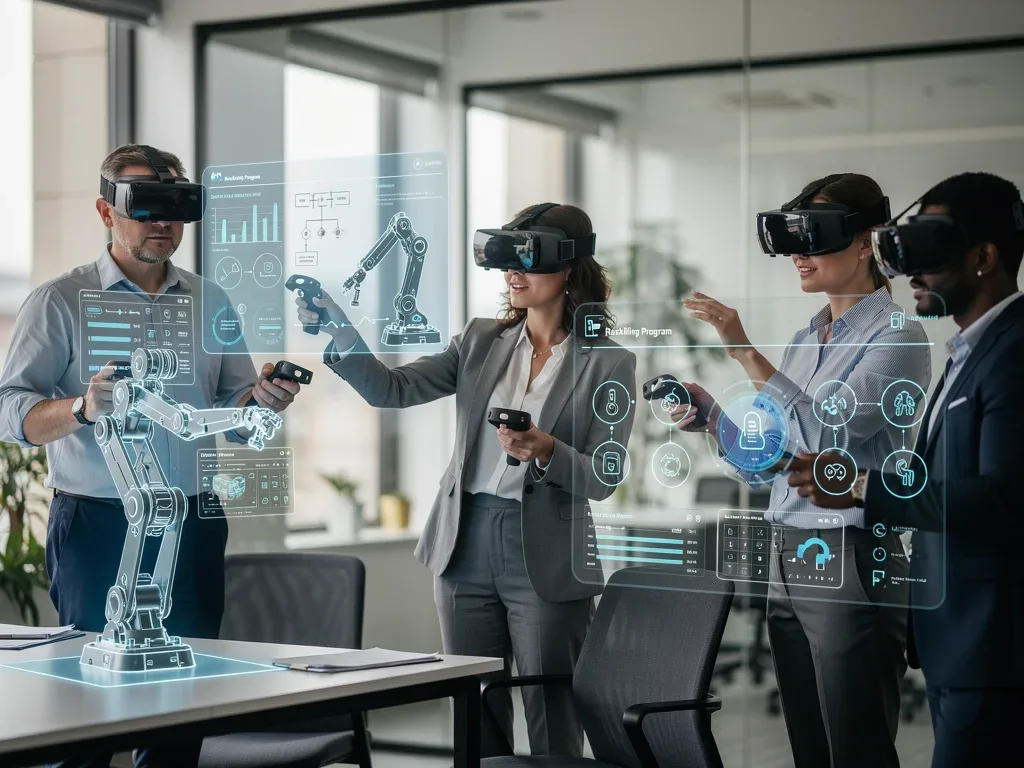
The educational system, from K-12 to higher education and vocational training, faces the challenge of integrating these new skill requirements into their programs. Lifelong learning initiatives, employer-sponsored training, and government-backed reskilling programs will be vital to ensure that the U.S. workforce remains competitive and adaptable in the face of rapid technological change. A proactive approach to skill development is not just beneficial, but essential for economic stability.
In conclusion, the evolving landscape of required skills is a central theme in the discussion of global automation trends. The emphasis is shifting towards a blend of advanced technical capabilities and uniquely human cognitive and socio-emotional skills. Investing in continuous learning and adapting educational frameworks will be key to empowering the workforce for the automated future.
Policy responses and workforce retraining initiatives
Addressing the profound shifts brought about by global automation trends requires robust policy responses and large-scale workforce retraining initiatives. Governments, educational institutions, and private sector companies must collaborate to create frameworks that support workers through this transition, ensuring economic stability and social equity. Without proactive measures, the benefits of automation could be unevenly distributed, exacerbating existing societal inequalities.
Policymakers are exploring various strategies, from adjusting unemployment benefits to funding extensive reskilling programs. The goal is not to halt automation, which is largely an unstoppable force, but to manage its impact on human labor effectively. This includes encouraging innovation while simultaneously protecting vulnerable workers and fostering pathways to new opportunities.
Key policy considerations
- Investing in STEM education: Strengthening foundational education in science, technology, engineering, and mathematics.
- Developing flexible training programs: Offering modular, accessible, and industry-relevant reskilling courses.
- Enhancing social safety nets: Re-evaluating unemployment insurance and considering universal basic income pilots.
- Promoting public-private partnerships: Collaborating on curriculum development and job placement initiatives.
- Incentivizing ethical AI development: Ensuring automation benefits society broadly and respects human values.
Workforce retraining initiatives are particularly critical. These programs need to be agile, responsive to market demands, and accessible to a diverse population, including older workers and those in rural areas. Digital platforms, micro-credentialing, and apprenticeships are emerging as effective models for delivering targeted and efficient training. The focus should be on transferable skills that can be applied across different industries, enhancing worker resilience.
The role of businesses in this ecosystem is equally vital. Companies can invest in upskilling their current employees, offer tuition assistance for relevant courses, and work with educational providers to shape training programs that meet their future talent needs. A shared responsibility between government, education, and industry will be essential for successfully navigating the automation era.
In conclusion, effective policy responses and comprehensive workforce retraining initiatives are indispensable for managing the impact of automation on the U.S. labor market by 2026. These efforts must be collaborative, forward-thinking, and designed to foster an adaptable and resilient workforce capable of thriving in an increasingly automated economy.
Economic implications for U.S. competitiveness
The pace of global automation trends will have significant economic implications for the U.S., particularly concerning its competitiveness on the world stage. Nations that effectively integrate automation and adapt their workforces will likely gain a substantial economic advantage. For the U.S., this means leveraging technological advancements to boost productivity, foster innovation, and maintain its position as a global economic leader, while also managing the internal challenges of labor market disruption.
Increased automation can lead to higher productivity and efficiency, which are crucial for economic growth. By automating routine and labor-intensive tasks, businesses can reallocate human capital to more complex, creative, and strategic roles. This can result in higher-quality goods and services, reduced costs, and faster market responsiveness, all contributing to a stronger competitive edge in global markets.
Factors influencing U.S. economic competitiveness
- Productivity gains: Automation’s ability to increase output per worker.
- Innovation capacity: Freedom for human workers to focus on R&D and new product development.
- Cost efficiencies: Lower production costs through optimized automated processes.
- Global talent attraction: Ability to attract and retain highly skilled workers in AI and robotics.
- Supply chain resilience: Automation reducing reliance on volatile labor markets and external factors.
However, failing to adapt effectively could jeopardize this advantage. If the U.S. workforce is not adequately prepared for the new skill demands, or if significant portions of the population are left behind, it could lead to social unrest, reduced consumer spending, and a decline in overall economic dynamism. The balance between technological advancement and societal well-being is delicate and critical for long-term competitiveness.

Furthermore, global competition in automation itself is intensifying. Countries like China and Germany are heavily investing in AI and robotics, aiming to lead in these transformative technologies. The U.S. must continue to foster an environment conducive to technological leadership, including robust funding for research and development, supportive regulatory frameworks, and policies that attract top talent worldwide. This proactive stance is essential to ensure that the U.S. remains at the forefront of the global automated economy.
In conclusion, the economic implications of global automation trends for U.S. competitiveness are profound. While automation offers immense potential for productivity and innovation, realizing these benefits requires strategic investments in workforce development, supportive policies, and a commitment to maintaining technological leadership. The success of the U.S. economy in 2026 and beyond will largely hinge on its ability to navigate these complex dynamics.
The rise of human-machine collaboration
One of the most exciting and perhaps most realistic outcomes of global automation trends by 2026 is the widespread adoption of human-machine collaboration. Instead of machines entirely replacing humans, we are increasingly seeing scenarios where humans and AI work synergistically, each contributing their unique strengths to achieve outcomes that neither could accomplish alone. This collaborative model is poised to become a cornerstone of the future of work.
In this collaborative paradigm, machines excel at tasks requiring speed, precision, data processing, and repetitive actions. Humans, on the other hand, bring creativity, critical thinking, emotional intelligence, ethical reasoning, and adaptability to unforeseen circumstances. When these capabilities are combined, the potential for innovation and efficiency is dramatically enhanced, leading to what is often termed ‘augmented intelligence.’
Benefits of human-machine collaboration
- Enhanced productivity: Humans focus on strategic tasks while machines handle routine work.
- Improved decision-making: AI provides data-driven insights, humans apply judgment and context.
- Greater innovation: Creative human thought augmented by AI’s analytical power.
- Reduced errors: Machines perform repetitive tasks with consistency, humans oversee and intervene.
- New job roles: Creation of ‘AI trainers,’ ‘robot supervisors,’ and ‘human-AI interface designers.’
Examples of human-machine collaboration are already emerging across various industries. In healthcare, AI assists doctors in diagnosing diseases, while human doctors provide empathy and complex treatment planning. In finance, algorithms identify market trends, but human analysts interpret these trends within broader geopolitical and social contexts. Even in creative fields, AI can generate initial concepts or analyze audience preferences, leaving artists to refine and personalize the output.
Successful human-machine collaboration requires careful design of workflows, effective communication protocols between humans and machines, and continuous training for workers to understand and interact with AI systems. It also demands a cultural shift within organizations, moving away from a mindset of competition between humans and machines towards one of partnership. This symbiotic relationship will be key to unlocking the full potential of automation without sacrificing human agency.
In conclusion, the rise of human-machine collaboration represents a significant and positive dimension of global automation trends. By 2026, this collaborative model will likely redefine many job roles, emphasizing the unique strengths of both humans and AI. Embracing and designing for this synergy will be crucial for maximizing productivity, fostering innovation, and creating a more resilient U.S. labor market.
Ethical considerations and societal impact
Beyond the economic and labor market shifts, global automation trends also raise profound ethical considerations and societal impacts that demand careful attention as we approach 2026. The widespread deployment of AI and robotics touches upon issues of privacy, fairness, accountability, and the very definition of human dignity in a technologically advanced society. Addressing these concerns proactively is crucial for ensuring that automation serves humanity’s best interests.
One major ethical challenge is algorithmic bias. If AI systems are trained on biased data, they can perpetuate and even amplify existing societal inequalities, particularly in areas like hiring, lending, or criminal justice. Ensuring fairness and transparency in AI algorithms is paramount to prevent discriminatory outcomes and maintain public trust. This requires diverse development teams and rigorous testing protocols.
Key ethical and societal challenges
- Algorithmic bias: Ensuring AI systems are fair and non-discriminatory.
- Data privacy: Protecting personal information in an increasingly data-driven world.
- Job quality and worker well-being: Preventing deskilling, ensuring meaningful work, and addressing mental health impacts.
- Digital divide: Preventing further inequality between those with and without access to technology and skills.
- Accountability: Determining responsibility when AI systems make errors or cause harm.
The societal impact extends to the nature of work itself. While automation can eliminate dangerous or mundane tasks, there’s a risk of deskilling or creating jobs that are overly monitored and devoid of human agency. Companies and policymakers must consider how to design automated work environments that enhance human dignity, foster skill development, and promote overall worker well-being. The psychological effects of working alongside intelligent machines also warrant further study and consideration.
Furthermore, the increasing reliance on automation can exacerbate the digital divide, creating a chasm between those who have access to technology and the skills to use it, and those who do not. This could lead to increased social stratification and limited opportunities for marginalized communities. Policies aimed at universal digital literacy and equitable access to advanced technologies are vital to counteract this potential outcome.
In conclusion, the ethical considerations and societal impact of global automation trends are as significant as their economic repercussions. By 2026, societies will be grappling with complex questions surrounding fairness, privacy, and human dignity in an automated world. A thoughtful and inclusive approach to these challenges is essential to ensure that technological progress benefits all segments of the U.S. population.
| Key Aspect | Brief Description |
|---|---|
| Job Transformation | Automation will displace routine jobs but create new roles requiring advanced technical and human skills. |
| Skill Evolution | Increased demand for critical thinking, creativity, emotional intelligence, and digital literacy. |
| Policy & Retraining | Government and industry must collaborate on reskilling programs and social safety nets. |
| Human-Machine Synergy | Future work will increasingly involve humans and AI collaborating to enhance productivity and innovation. |
Frequently asked questions about automation’s impact
Will automation lead to mass unemployment in the U.S. by 2026?▼While automation will displace jobs in certain sectors, particularly routine ones, it is also expected to create new roles. The net effect on employment by 2026 is complex, with many experts predicting a shift in job types rather than widespread mass unemployment, provided effective retraining initiatives are in place.
What skills will be most valuable in an automated U.S. job market?▼Highly valued skills will include critical thinking, creativity, problem-solving, emotional intelligence, and digital literacy. Technical skills in AI, data science, and cybersecurity will also be in high demand, emphasizing human-centric capabilities that machines cannot easily replicate.